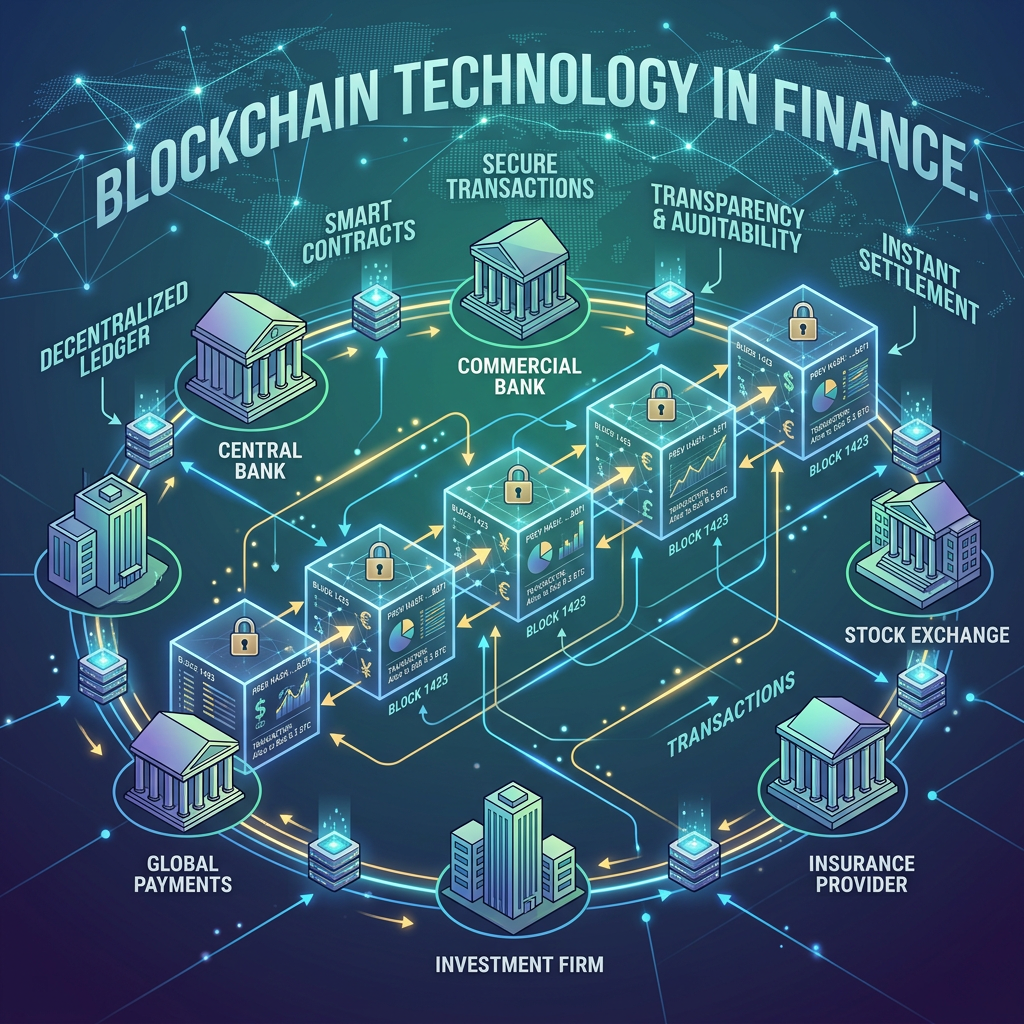
The financial sector has undergone remarkable transformation over the past few decades, driven largely by digital innovation and globalization. Among the most disruptive advancements is Blockchain Technology, which has introduced a decentralized and transparent way of recording and verifying transactions. Initially popularized by cryptocurrencies, blockchain has evolved into a broader infrastructure with the potential to reshape financial systems worldwide. Its decentralized nature challenges traditional intermediaries, offering efficiency, security, and inclusivity. However, alongside these promising benefits come significant challenges that institutions, regulators, and users must address.
Understanding Blockchain in the Financial Context
Blockchain is essentially a distributed ledger system that records transactions across multiple nodes in a network. Unlike traditional centralized databases, where a single authority maintains records, blockchain operates on a consensus mechanism that ensures all participants agree on the validity of transactions. Each block contains a list of transactions, and once added to the chain, it becomes nearly immutable.
In finance, this technology eliminates the need for intermediaries such as banks or clearinghouses for certain processes. Transactions can be executed directly between parties, reducing time delays and operational costs. Smart contracts, which are self-executing agreements coded into the blockchain, further enhance automation by enforcing predefined conditions without human intervention.
Opportunities Presented by Blockchain in Finance
Enhanced Transparency and Trust
One of the most significant advantages of blockchain is its transparency. Every transaction recorded on a blockchain is visible to all participants, creating a system where data integrity is easily verifiable. This reduces the risk of fraud and manipulation, which are common concerns in traditional financial systems.
Financial institutions can leverage this transparency to build trust with customers and stakeholders. For example, cross-border transactions often involve multiple intermediaries, making it difficult to track funds. Blockchain simplifies this process by providing a single, shared ledger that records every step of the transaction.
Improved Efficiency and Cost Reduction
Traditional financial processes often involve multiple layers of verification, leading to delays and increased costs. Blockchain streamlines these processes by automating verification through consensus algorithms. This significantly reduces transaction times, particularly in areas like international payments and settlements.
Banks and financial service providers can save substantial operational costs by adopting blockchain-based solutions. For instance, clearing and settlement processes that typically take days can be completed in minutes, enhancing liquidity and reducing counterparty risk.
Financial Inclusion
Blockchain has the potential to bring financial services to underserved populations. In many parts of the world, individuals lack access to banking infrastructure due to geographical or economic barriers. Blockchain-based platforms can provide decentralized financial services, enabling users to transact, save, and invest without relying on traditional banks.
Mobile-based blockchain applications are particularly impactful in developing regions, where smartphone penetration is higher than access to physical banks. This opens new avenues for economic participation and empowerment.
Security and Data Integrity
Cybersecurity is a major concern in the financial sector, with data breaches and hacking incidents posing significant risks. Blockchain enhances security through cryptographic techniques and decentralized storage. Since data is distributed across multiple nodes, it becomes extremely difficult for attackers to alter or compromise the system.
Additionally, the immutability of blockchain records ensures that once a transaction is recorded, it cannot be changed without consensus from the network. This provides a reliable audit trail, which is crucial for regulatory compliance and dispute resolution.
Innovation in Financial Products
Blockchain is enabling the creation of innovative financial products and services. Decentralized finance (DeFi) platforms, for example, offer lending, borrowing, and trading services without traditional intermediaries. Tokenization of assets allows physical assets like real estate or commodities to be represented digitally, making them more accessible and liquid.
These innovations are expanding the scope of financial markets and creating new opportunities for investors and entrepreneurs.
Challenges Facing Blockchain in Finance
Regulatory Uncertainty
Despite its potential, blockchain faces significant regulatory challenges. Governments and regulatory bodies are still grappling with how to oversee blockchain-based systems. The decentralized nature of blockchain makes it difficult to apply traditional regulatory frameworks.
Uncertainty around compliance requirements can hinder adoption, as financial institutions must ensure they operate within legal boundaries. Clear and consistent regulations are essential to foster trust and encourage innovation.
Scalability Issues
Scalability remains a major concern for blockchain networks. As the number of transactions increases, the network can become congested, leading to slower processing times and higher fees. This is particularly evident in public blockchains used for cryptocurrencies.
For blockchain to be widely adopted in finance, it must handle high transaction volumes efficiently. Ongoing research and development efforts aim to address these challenges through solutions like layer-two protocols and improved consensus mechanisms.
Energy Consumption
Some blockchain networks, particularly those using proof-of-work consensus mechanisms, consume significant amounts of energy. This raises environmental concerns and questions about sustainability.
The financial sector is increasingly focused on environmental, social, and governance (ESG) criteria, making energy-intensive blockchain systems less attractive. Transitioning to more energy-efficient consensus models, such as proof-of-stake, is crucial for long-term viability.
Integration with Legacy Systems
Financial institutions rely heavily on existing infrastructure, which may not be compatible with blockchain technology. Integrating blockchain with legacy systems can be complex and costly.
Organizations must carefully evaluate how to incorporate blockchain without disrupting existing operations. This often requires significant investment in technology and training, as well as collaboration with industry partners.
Privacy Concerns
While blockchain offers transparency, it can also raise privacy concerns. Financial transactions often involve sensitive information that must be protected. Public blockchains, where data is accessible to all participants, may not be suitable for certain financial applications.
Developing privacy-enhancing technologies, such as zero-knowledge proofs and permissioned blockchains, is essential to address these concerns and ensure compliance with data protection regulations.
The Future of Blockchain in Finance
The future of blockchain in finance is promising but uncertain. As technology continues to evolve, it is likely to play an increasingly important role in shaping financial systems. Collaboration between governments, financial institutions, and technology providers will be key to overcoming challenges and unlocking the full potential of blockchain.
Central bank digital currencies (CBDCs) are one area where blockchain is gaining traction. Many countries are exploring the use of blockchain to issue digital versions of their national currencies, aiming to enhance payment systems and financial stability.
Moreover, advancements in interoperability are enabling different blockchain networks to communicate with each other. This could lead to a more connected and efficient financial ecosystem, where assets and data can move seamlessly across platforms.
Conclusion
Blockchain is undeniably transforming the financial landscape by introducing new levels of transparency, efficiency, and innovation. Its ability to eliminate intermediaries and automate processes presents significant opportunities for cost savings and improved services. At the same time, challenges such as regulatory uncertainty, scalability, and privacy must be addressed to ensure sustainable growth.
As the financial industry continues to adapt, the role of Blockchain Technology will likely expand, influencing everything from payments to asset management. By balancing innovation with regulation and addressing technical limitations, stakeholders can harness the full potential of blockchain to create a more inclusive and resilient financial system.

